

Pittsburgh Is on the Clock. So Is Your Data.
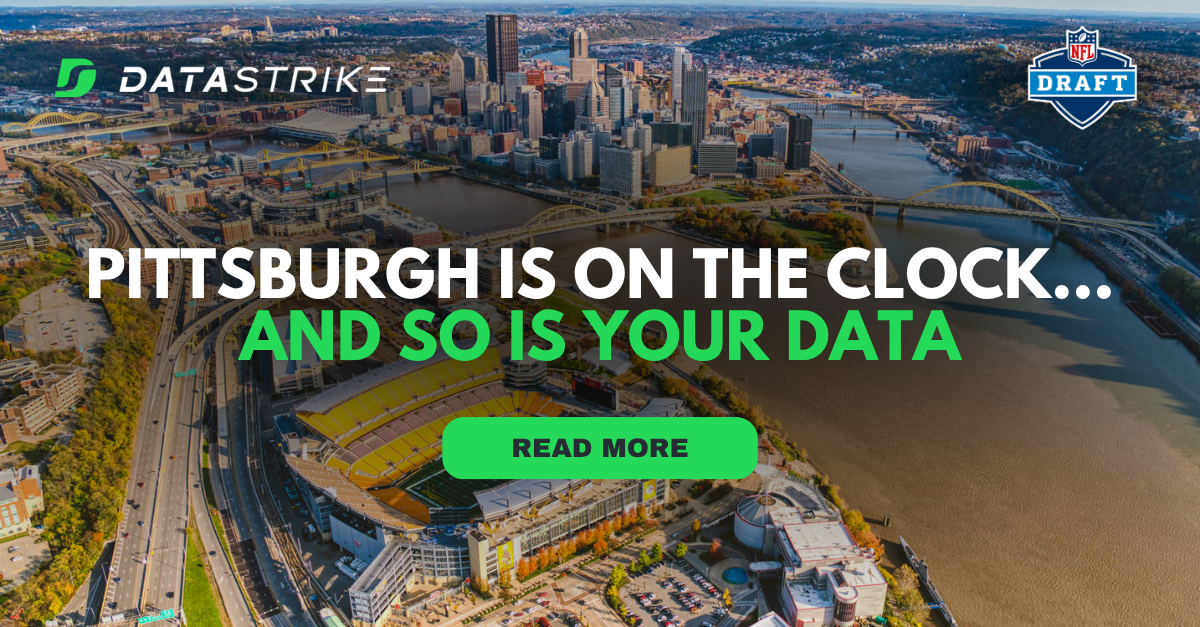
The NFL Draft lands in our backyard April 23–25. Behind the picks, the trades, and the 600,000+ fans converging on the North Shore is something most people never think about: an extraordinary data operation. Here's what it teaches the rest of us.
Pittsburgh doesn't need much of an introduction right now. For the first time since 1947, every NFL franchise, hundreds of college prospects, and an estimated 500,000 to 700,000 fans will descend on the city. The stage is Acrisure Stadium and Point State Park, on opposite sides of the Allegheny River. The stakes are high. The pressure is real.
We're a Pittsburgh data managed services company. We manage the databases, data platforms, and analytics infrastructure that keep some of the region's most complex organizations running. So when the NFL Draft rolls into town, we notice something most coverage misses: \at its core, it’s a massive data management challenge. Two of them, actually.
One in every NFL draft room. One in the city hosting it. Both have something to teach every IT leader reading this.
Hosting 600,000 People Is a Real-Time Data Problem
Before a single name gets called on Thursday night, Pittsburgh has already solved a logistics puzzle few cities face. How do you move, monitor, and protect 600,000 people across a constrained urban geography where three rivers and limited bridges create natural bottlenecks?
The answer, according to Carnegie Mellon University's Sean Qian, comes down to data. Qian leads CMU's Mobility Data Analytics Center and has been studying Pittsburgh's transportation systems in the lead-up to the Draft [1].
"This is going to be a big issue, because Downtown Pittsburgh is constrained by the limited capacity of bridges and tunnels... How do you route emergency vehicles through the city?" DR. SEAN QIAN, CMU MOBILITY DATA ANALYTICS CENTER
That question isn't hypothetical. The 2024 NFL Draft in Detroit covered roughly two million square feet across 46 acres of urban space [2]. It’s less a fan festival and more as a temporary city dropped on top of an existing one. Every system that the city runs, from traffic signals to emergency response routing to cellular capacity, has to be modeled in advance and monitored in real time.
For Pittsburgh, that preparation involved months of coordination across state and local agencies. Pennsylvania officials ran walk-throughs, traffic modeling, risk assessments, and interagency drills. The city approved $1 million in Draft-specific funding. The state granted $10 million through its Marquis Events program. Total public investment topped $18.9 million [3].
Verizon didn't wait to find out what would happen to cell networks under that kind of load. They built a new tower at Point State Park specifically for the event [4]. You don’t improvise real-time infrastructure at scale. You plan it, instrument it, and monitor it continuously.
The economic projection is equally data-driven. Analysts have modeled everything from hotel room nights to rideshare surges to restaurant spend across Allegheny, Washington, Butler, Beaver, and Westmoreland counties. For context: Detroit generated $219 million in economic activity from its 2024 Draft. Philadelphia produced $94.9 million in 2017, Nashville $133 million direct and $224 million total in 2019 [5]. Pittsburgh's target sits between $120 million and $200 million, based on modeling that accounts for hotel capacity, transit load, and visitor spend patterns from prior host cities.
DATASTRIKE PERSPECTIVE
What Pittsburgh is managing right now mirrors what most organizations deal with every day, just at a different scale: multiple data streams, multiple stakeholders, decisions that have to be made in real time without the luxury of being wrong. Traffic analytics, crowd flow, emergency routing, and economic modeling. It’s not far off from database performance monitoring, capacity planning, and incident response across your production environment.
The city didn't cobble this together at the last minute. It took months of planning, the right data infrastructure, and people who knew how to read the outputs. Your data estate needs the same discipline.
Inside the Draft Room: How NFL Teams Actually Use Data
While Pittsburgh manages crowd flow and bridge capacity, something equally complex is happening inside every team's war room. Thirty-two franchises are each sitting on years of player data, machine learning models, AI-assisted scouting tools, and decisions worth hundreds of millions of dollars. The clock is literal. When it's your pick, you go.
This wasn't always the case. For most of the National Football League’s history, draft decisions came down to film study, combine performance, and gut instinct. The "feel" for a player. The eye test. Scouting was an art form, not a science. That's changed fast.
The Infrastructure Behind Player Evaluation
Start with what the NFL has built at the game level. The Next Gen Stats platform, developed in partnership with Zebra Technologies and running entirely on Amazon Web Services, embeds RFID chips in every player's shoulder pads and inside the football itself [6].
Ultra-wideband receivers mounted across every stadium capture the X/Y coordinates of all 22 players ten times per second.
The result? The system now produces between 500 and 1,000 unique data points per play. Seventy-five machine learning models running on AWS process that data in under a second [7]. In 2017, this moved from an experiment to critical league infrastructure. By 2018, every franchise was on the same analytical footing.
"Analytics allowed us to gather so much information. The interesting thing about AI is that it analyzes, too. So it's a different level." ROB BRZEZINSKI, INTERIM GENERAL MANAGER, MINNESOTA VIKINGS — VIA ESPN
For draft evaluation specifically, the NFL launched Draft IQ, powered by Amazon QuickSight, which processes historical patterns, live draft data, team needs, offensive and defensive scheme fits, trade probabilities, and GM strategic tendencies into a real-time analytics dashboard that updates every five minutes during the live draft [8].
AI Is in the Draft Room. For Real.
This year's draft conversation has a clear theme: AI is no longer a novelty in team front offices. It's expected infrastructure. Raiders GM Tom Telesco is using systems like Microsoft Copilot alongside AWS Next Gen Stats to process data no human staff could realistically touch: play-by-play logs, RFID biometrics, acceleration curves, fatigue indicators, and injury history flags [9].
For players who skip Combine drills, like Ohio State safety Caleb Downs who didn't run the 40, AI fills the gap. Computer vision tools analyze college game film frame by frame, generating objective speed ratings comparable to NFL Next Gen Stats data [10]. The goal isn’t a yes or no answer on a prospect. It's probability modeling: how likely is this player to succeed in a specific role, within a specific scheme, under specific usage conditions?
Right here in Pittsburgh, Carnegie Mellon's Sports Analytics Center has been a quiet force in this evolution. Dr. Ron Yurko leads the work, and the framing is exactly right:
"These are concepts that scouts and coaches would be looking at before, but now we can directly and objectively measure them based on data." DR. RON YURKO, CARNEGIE MELLON SPORTS ANALYTICS CENTER — VIA CBS PITTSBURGH
CMU has had graduates go on to work in analytics for NFL teams. Their goal is clear: identify what traits are meaningful at the professional level, then track those traits back to the college level to improve draft targeting. That's not sci-fi. It’s a working data pipeline.
The Human + Machine Balance
What no team has done is hand the draft board to an algorithm. . When the Rams' GM Les Snead joked about "turning it all over to Claude," he was making a point: the machine doesn't decide [11]. Analytics gives decision-makers more accurate information faster. The judgment still belongs to people who know the game.
Rick Spielman, former Vikings GM, described his analytics team as maintaining a database of every player scouted over the prior 15 years, which is used to run historical comparisons against incoming prospects [12]. That's not a side project. That's core infrastructure.
DATASTRIKE PERSPECTIVE
Every team's scouting database is only as good as its architecture. You can have the best analyst in the room, but if the underlying data is siloed, stale, or inconsistently modeled, the insights are garbage. That's true in the draft room and it's true in your business.
The NFL teams winning on data aren't the ones with the flashiest tools. They're the ones with clean, trusted data, a clear schema, and senior analysts who know how to ask the right questions. That's what we build for our clients. Not dashboards. Decisions.
What the NFL's Playbook Means for Your Organization
There are two types of organizations right now. The ones that know what their data says. And the ones that think they do.
The NFL has spent a decade building the infrastructure to close that gap. RFID hardware in 2014. AWS partnership formalized in 2017. League-wide data access in 2018. Machine learning at scale in 2019. AI-assisted scouting today. That's not a transformation that happened in a sprint. It's a deliberate, sequenced build on a solid data foundation.
Most mid-market organizations are somewhere in the middle of that timeline. They have data. They have tools. They may even have dashboards. What they often lack is the underlying infrastructure that makes those tools trustworthy: clean databases, reliable pipelines, senior-level engineering that knows when something is wrong before the business feels it.
The city of Pittsburgh didn't wait until 600,000 people showed up to figure out the bridge bottlenecks. NFL teams didn't wait until pick day to build their scouting databases. They invested in the infrastructure well before they needed it under pressure.
Your data infrastructure should work the same way. Not when the incident hits. Not when the audit starts. Not when the board asks a question you can't answer. Before any of that. Continuously. With people who've done it before at the highest level.
That's what DataStrike does. We're a Pittsburgh-based managed services company built entirely around data. Database administration, cloud platforms, business intelligence, application support. One team. One contract. Every layer of your data estate. 100% onshore, senior-level engineers who run your environment the way an NFL analytics department runs a draft room: with precision, accountability, and no guesswork.
THE DATASTRIKE TEAM
DataStrike is a Pittsburgh-based managed data services company. Our team of 100% onshore, senior-level engineers manages the full data estate for mid-market organizations — database administration, cloud platforms, business intelligence, and application support. We don't sell tools. We run your data. One team, one contract, every layer. datastrike.com
SOURCES
- Carnegie Mellon University (2026, March). What the NFL Draft Will Mean for Pittsburgh Traffic. https://www.cmu.edu/news/stories/archives/2026/march/what-the-nfl-draft-will-mean-for-pittsburgh-traffic
- University of Texas at Arlington (2026, April 3). NFL Draft Boosts Economy, But Raises Safety Costs. https://www.uta.edu/news/news-releases/2026/04/03/nfl-draft-boosts-economy-but-raises-safety-costs
- PublicSource (2026, March). Will the NFL Draft Payoff Make the $19M Public Investment Worth It? https://www.publicsource.org/nfl-draft-spending-public-investments/
- CBS Pittsburgh (2026). 2026 NFL Draft: Transit, Traffic, Events and Updates. https://www.cbsnews.com/pittsburgh/news/cell-phone-tower-point-state-park-nfl-draft/
- Allegheny Institute for Public Policy (n.d.). NFL Draft Impact Analysis. https://www.alleghenyinstitute.org/nfl-draft-impact/
- NFL Football Operations (n.d.). NFL Next Gen Stats Overview. https://operations.nfl.com/gameday/technology/nfl-next-gen-stats/
- Amazon Science (2026, February). A Decade of NFL Next Gen Stats Innovation. https://www.amazon.science/blog/a-decade-of-nfl-next-gen-stats-innovation
- Amazon Web Services (n.d.). NFL Draft IQ: From Combine to Draft Day. https://aws.amazon.com/nfl-iq/
- Abstract Sports (2026, March). The Impact of AI Analytics on NFL Draft Strategies in 2026. https://abstractsports.com/blog/the-impact-of-ai-analytics-on-nfl-draft-strategies-in-2026
- ESPN (2026, April). How AI Is Changing NFL Draft Prep to ‘a Different Level. https://www.espn.com/nfl/story/_/id/48446759/nfl-draft-combine-artificial-intelligence-caleb-downs-arvell-reese-david-bailey
- CrunchSports (2026). NFL Teams Turn to AI to Scout Draft Prospects. https://www.crunchsports.com/nfl/nfl-teams-turn-to-ai-to-scout-draft-prospects/
- Schneider Downs (n.d.). Data Analytics Use in the NFL Draft. https://schneiderdowns.com/our-thoughts-on/data-analytics-and-the-nfl-draft/
- CBS Pittsburgh (2026). Carnegie Mellon Analytics Helping Shape NFL Draft Decisions. https://www.cbsnews.com/pittsburgh/news/nfl-draft-analytics-carnegie-mellon-university/
Frequently Asked Questions (FAQs) - Data, the NFL Draft, and Pittsburgh
How are NFL teams using data analytics in the 2026 NFL Draft?
Teams are using AI-assisted scouting platforms, machine learning models, and the NFL's Next Gen Stats infrastructure (built on AWS) to evaluate player performance beyond traditional combine metrics. Tools like Draft IQ, powered by Amazon QuickSight, give teams real-time dashboards that analyze scheme fit, trade probabilities, and draft tendencies. Computer vision is also being used to generate objective speed ratings for players who skip combine drills, filling gaps that scouts previously had to guess at.
What is the economic impact of the 2026 NFL Draft in Pittsburgh?
Pittsburgh is projected to generate between $120 million and $200 million in regional economic activity from the 2026 NFL Draft, with 500,000 to 700,000 visitors expected over the three-day event. Local, state, and county governments committed over $18.9 million in public funding toward hosting. For comparison, Detroit generated $219 million in economic impact from the 2024 Draft.
What data infrastructure challenges does hosting the NFL Draft create for a city?
Hosting an event at this scale requires real-time management of traffic flow, emergency response routing, cellular network capacity, and economic tracking across multiple counties. Pittsburgh worked with agencies including Carnegie Mellon's Mobility Data Analytics Center to model traffic patterns well in advance. Verizon installed a new cell tower at Point State Park specifically to handle the surge in data demand. Months of interagency coordination, scenario-based drills, and transportation planning were required before a single fan arrived.
What is NFL Next Gen Stats and how does it work?
NFL Next Gen Stats is a player and ball tracking platform developed in partnership with Zebra Technologies and running on Amazon Web Services. RFID chips embedded in every player's shoulder pads and inside the football capture location data 10 times per second. The system now runs 75 machine learning models on AWS, producing between 500 and 1,000 unique data points per play. It has been a core part of NFL infrastructure since a formal AWS partnership was established in 2017.
Does Carnegie Mellon University contribute to NFL analytics?
Yes. CMU's Sports Analytics Center, led by Dr. Ron Yurko, conducts research into advanced player tracking metrics and how data reveals performance attributes that traditional scouting methods miss. CMU graduates have gone on to work analytics roles for NFL teams. The university also played a key role in modeling Pittsburgh's transportation challenges for the 2026 Draft through its Mobility Data Analytics Center.
What does DataStrike do and how is it related to Pittsburgh?
DataStrike is a Pittsburgh-based managed data services company. We provide database administration, cloud services, business intelligence, and application support to mid-market organizations across the country. Our entire team is onshore, senior-level, and focused exclusively on data. We run the data infrastructure so your team can focus on using it. With the 2026 NFL Draft in Pittsburgh, we're proud to call this city home and to be part of its growing reputation as a serious technology and analytics hub.
Your data estate deserves a first-round draft pick.
Most organizations are running on a data infrastructure that was never designed for what they're asking it to do now. We fix that. One team, every layer, no guesswork. Talk to a Senior Expert today.
More from DataStrike
.png)


