What Is HITRUST and Why Does Your Data Platform MSP Need to Be Compliant?
Why HITRUST Compliance Matters When Choosing a Managed Services Provider
By Corey Beck, VP of Service Delivery at DataStrike
When IT leaders evaluate a managed services partner, the conversation usually centers on capabilities, response times, and cost. Security compliance tends to come up later, in a procurement questionnaire or when a client's legal team gets involved.
By then, you are already behind.
HITRUST is one of the most rigorous security frameworks a technology organization can adopt. For companies managing sensitive data in healthcare, financial services,or any regulated industry, the compliance posture of your MSP directly affects your own risk exposure. If your data platform partner is not HITRUST-aligned, that gap belongs to you.
Below, I break down what HITRUST actually means and why we built our operations around it. More to the point, what it should tell you about any vendor that touches your data environment.
What Is HITRUST?
HITRUST stands for Health Information Trust Alliance. TheirCommon Security Framework, the CSF, maps requirements from HIPAA, NIST 800-53, ISO 27001, SOC 2, and CIS Controls into one auditable program. Rather than managing compliance against each standard separately, HITRUST gives organizations a single rigorous framework that satisfies all of them.
Formal certification is not self-attested. An accredited third-party assessor validates your controls, reviews documented evidence, and submits findings to HITRUST for independent quality review before any certification is issued.
Organizations that align to HITRUST simultaneously demonstrate compliance with multiple regulatory and contractual frameworks, which is why health plans accept HITRUST as evidence of compliance rather than requiring separate HIPAA audits or SOC 2 reviews.
HITRUST offers three certification levels:
- The e1 covers foundational controls for lower-risk environments.
- The i1 validates a broader active control set against known threat scenarios.
- The r2 is the most rigorous, covering over 2,000 prescriptive controls with full third-party assessment and mandatory reassessment every two years. It is the level regulated industries and enterprise clients reference when evaluating vendor security.
Does HITRUST Compliance Actually Reduce Breach Risk?
The performance data on HITRUST-aligned environments makes a clear case.
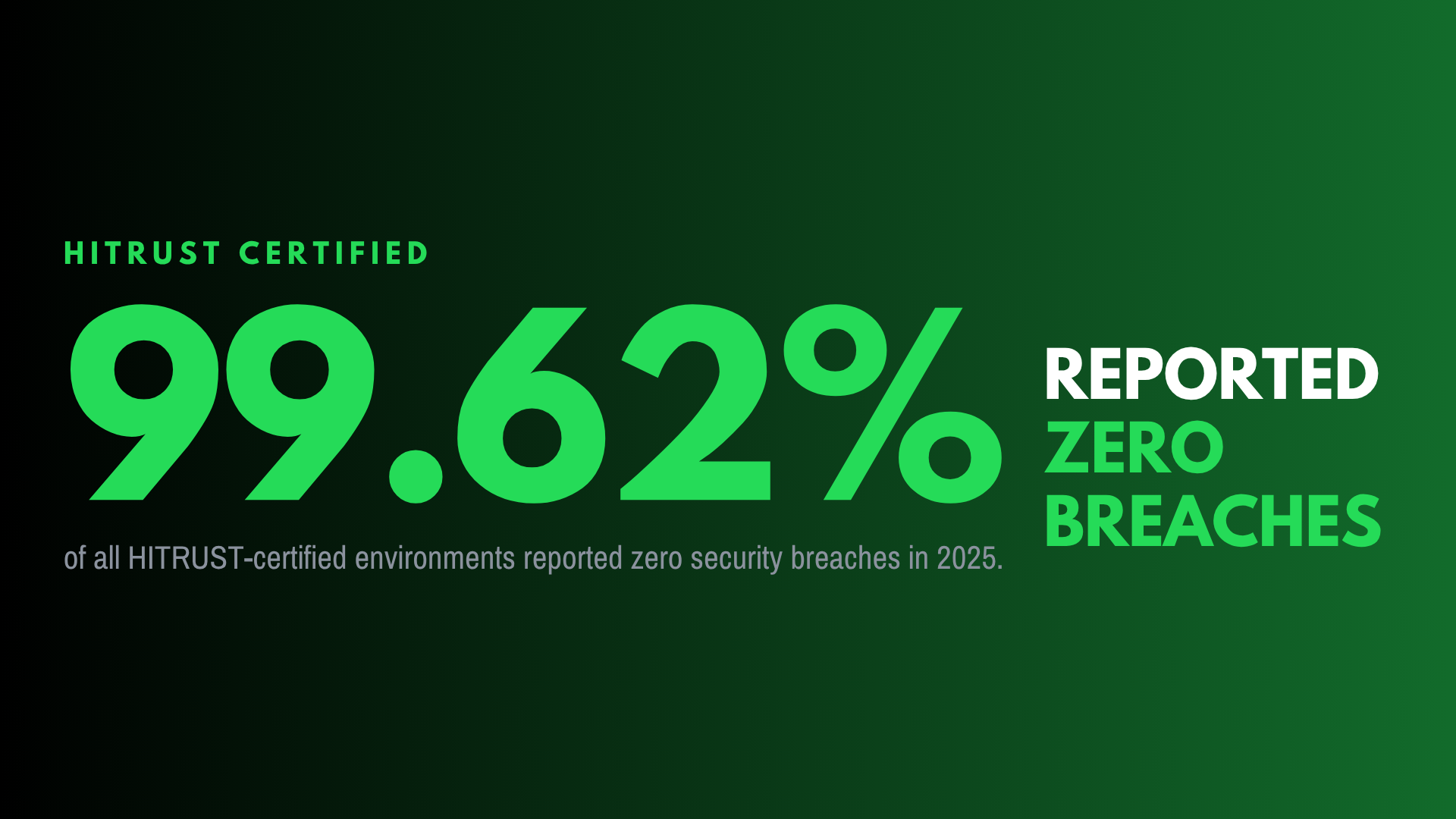
The 2026 HITRUST Trust Report found that 99.62% of HITRUST-certified environments did not report a security breach in 2025. By comparison, multiple independent cybersecurity surveys indicate that more than 40% of organizations have experienced a security breach.
None of the top 50 healthcare breaches reported in the Department of Health and Human Services OCR breach portal occurred in HITRUST-certified environments.
The financial stakes are real. Healthcare data breaches averaged $9.77 million per incident in 2024 according to IBM's Cost of a Data Breach Report, making it the most expensive sector for breaches for the 14th consecutive year.
These figures describe what happens when security controls are absent or untested. They apply to your organization whether the breach originates internally or through a vendor with access to your systems.
Why Your MSP's Compliance Is Your Risk
When you bring in a managed services partner to run your databases, data platforms, or cloud infrastructure, you grant them access to the core of your data environment. That includes credentials, configuration management, backup systems, and often data subject to regulatory requirements.
In 2024, 30% of all data breaches involved a third-party vendor, twice the rate of the prior year. According to IBM's Cost of a Data Breach Report, breaches involving a supply-chain compromise cost $4.91 million on average.
Regulators do not distinguish between organizational or third-party vendor breaches. The accountability lands with your organization. A Business Associate Agreement covers liability on paper, but it won't restore your data or explain the incident to your board.
In 2024, 35.5% of all breaches were third-party related, and 41.4% of ransomware attacks started through a third party. The compliance posture of every vendor with access to your environment is a required evaluation criterion, not a secondary one.
What HITRUST Compliance Looks Like in a Managed Services Operation
Real compliance is measured by a team’s day-to-day operations, not in a document filed away in a folder. At DataStrike, our HITRUST alignment shapes access controls, change documentation, and incident response at the delivery level.
Access control. Every engineer's access to a client environment is provisioned through a defined process and scoped to exactly what the engagement requires. When the work ends, that access is revoked the same day. No shared credentials. No standing access without documented justification.
Change management. Production changes go through a documented approval workflow. Every modification is tied to a ticket and reviewed before it runs. All of it gets logged. When a client or auditor asks what changed and when, there is a verifiable record.
Incident response. We maintain documented response procedures with defined timelines and escalation paths. Clients receive communication on a set, predictable schedule.
Audit logging. Activity across the environments we manage is logged and retained. This supports both security monitoring and the compliance documentation clients need when facing their own audits.
Subcontractor accountability. HITRUST requires that any third party with access to a client environment be subject to equivalent controls. According to the 2026 HITRUST Trust Report, over 80% of HITRUST certifications, including 100% of r2 certifications, address the threats presented by an organization's service providers. DataStrike's delivery is 100% onshore with senior engineers. There are no offshore handoffs and no work routed through teams operating outside these standards.
That last point is worth pressing on with any vendor you evaluate. An MSP can claim HITRUST alignment while routing delivery through teams not actually covered by those controls, so it’s important to verify.
What to Ask Any MSP About Their HITRUST Compliance
These questions separate a credible program from compliance theater.
- Are you HITRUST-aligned, and at what level are you working toward or operating against? Ask for specifics on where they are in the process and what controls are actively in place. Verifiable through the HITRUST MyCSF portal.
- Does your compliance program cover all engineers and subcontractors? A parent entity's alignment does not automatically extend to all delivery personnel.
- Where is your delivery team located? Offshore delivery introduces jurisdictional and access control complexity that alignment documentation alone does not resolve.
- What is your documented incident response SLA, and who is notified first? If there is no documented answer, the program is not mature.
Confident, specific answers indicate a program that operates. Vague answers tell you just as much.
The Bottom Line
Compliance has stopped being a differentiator and become a baseline expectation, written into vendor selection, client contracts, and cyberinsurance underwriting. The risk does not originate only inside your walls.
Choosing a partner who builds operations around rigorous, independently validated security standards means you are not constructing that program yourself. The controls are already in place and independently tested. When your next audit or security questionnaire asks about your managed services partners, you have a documented, defensible answer.
That defensible answer is what HITRUST alignment from your MSP actually buys you.
Frequently Asked Questions (FAQs)
What is HITRUST?
HITRUST, the Health Information Trust Alliance, developed the Common Security Framework, a unified compliance program that maps requirements from HIPAA, NIST 800-53, ISO 27001, SOC 2, and CIS Controls into a single auditable standard. It is widely referenced across healthcare, financial services, and regulated industries as the benchmark for vendor security evaluation.
Is HITRUST only relevant for healthcare organizations?
No. HITRUST originated in healthcare but is now a standard vendor evaluation requirement in financial services, insurance, and government contracting. Cyberinsurers and enterprise procurement teams increasingly require HITRUST alignment regardless of industry.
Does HITRUST compliance reduce the risk of a data breach?
The 2026 HITRUST Trust Report found that 99.62% of certified environments did not report a breach in 2025, compared to more than 40% of organizations broadly reporting breach experience. None of the top 50 healthcare breaches in the HHSOCR portal occurred in HITRUST-certified environments.
Why does my MSP's HITRUST compliance affect my organization?
When a managed services partner has access to your data environment, their security posture is your exposure. In 2024, 30% of all breaches involved a third-party vendor. Regulators do not distinguish between a direct breach and one that entered through a vendor. The accountability is yours either way.
What should I ask an MSP about their HITRUST compliance?
Ask whether their compliance program covers all delivery personnel including subcontractors, where their engineers are located, what controls are actively in place, and what their documented incident response SLA looks like. A credible program has specific answers to all of these.
What is the difference between HITRUST e1, i1, and r2?
e1 covers foundational controls for lower-risk environments. i1 validates a broader active control set against known threat scenarios. r2 is the most rigorous level, requiring independent assessment of over 2,000 controls and mandatory reassessment every two years. Regulated industries and enterprise clients typically require r2.
Corey Beck is the VP of Service Delivery at DataStrike, a data platform managed services firm serving mid-market IT leaders across the full data estate including databases, cloud, analytics, and AI infrastructure. DataStrike is headquartered in Warrendale, PA.
More from DataStrike
.png)