The DataStrike Decision-Makers: Tips from an IT Leader Part 2
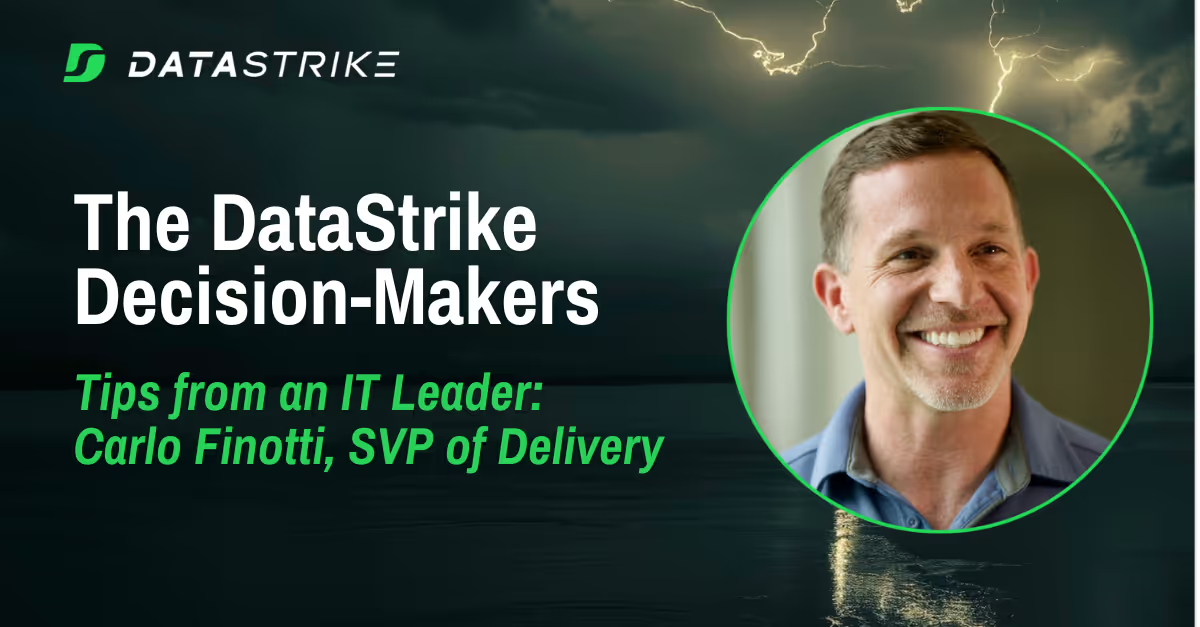
An IT Leader's Take on Culture, Budgets, and What's Next in Tech: Part 2
We sat down with Carlo Finotti, our newly minted Senior Vice President of Service Delivery, to wrap up the second part of our interview. If you missed the first blog in our series, don’t worry, you can catch up here. Continue reading below for more exciting predictions, revelations, and discourse on the world of technology.
So, you worked at Rue21 as a customer and now work here as a leading DataStrike Decision maker? Tell me, why did you decide to make this transition? What inspired it?
Finotti: I’ve been inside organizations as a decision maker, but ultimately what I wanted to do was get into IT as a business. I wanted to be a part of the core of the business. From a leadership perspective, IT is the business. When you work inside of a company, you’re a value-added partner of the overall organization, but you’re not “driving revenue.” When it comes to IT, there are technology groups inside of a business that do drive revenue because business usually cannot do much without IT. The other part of it was that I wanted to come into a business with these services platforms that I saw, and I saw what folks were doing right and wrong. Having the ability to make the right decisions to support customers and be on the other side of supporting them was a goal of mine while adding value. I saw how often a Managed Service Provider (MSP) helped us through major projects and the general service model. I wanted to be on the other side of that, creating value rather than just being inside one organization's being inside one organization.
What’s one big innovation you thought might change the field of data infrastructure but didn’t?
Finotti: The electric vehicle (EV) has been prominent recently, and I thought all car manufacturers would adopt it. Instead, we’re now seeing hybrid take center stage. What Tesla did was shake the entire market. Everyone basically stepped over hybrid because they all wanted to achieve 60 mpg while still getting the power of an EV – specifically for trucks. Now, people are looking at hybrid as more of a long game, so manufacturers are diving back into the hybrid market. Now, when we specifically reference technologies, I’m sure something will come to me (15 minutes later, something did in fact come to him...as we had just wrapped up the last question...). A technology that fell flat that I seriously thought would take off was the Microsoft Windows phone. There was a big push between Blackberry phasing out, and iPhone and Android coming in. I kept saying that businesses were having issues integrating Android and iPhone, and Microsoft was kicking off their cloud (this was around 2012). I really thought that the phone could see a trajectory because of the integration with Microsoft. It just never gained traction, but I thought it would hold a large market share. The Windows phone was a little clunky; it was basically a mini version of Windows on a phone. It had a bad user interface (UI) and didn’t take on apps like iPhones did. While on the other side, Apple was struggling to work with PowerPoint and all these apps, as was BlackBerry. But I don’t think we could’ve predicted that Blackberry would fall off. Back in 2006, we were heavy users because it was the mobile device of the company I worked for. If you were going to do email, it was BlackBerry only.
How do you ensure IT projects are delivered in a timely fashion and within budget?
Finotti: It first starts with scoping effectively. If you don’t scope properly, you end up having scope creep (defined as the scope of a project gradually expanding beyond its original objectives and boundaries, often due to unplanned changes or additions) which creates budget expansion and project timeline delays. Monumental data warehouses or very large enterprise application deployments have a ton of scope, and you can easily go outside of your budget, so you have to be strategic from a resource perspective.
Do you believe this year, given the current volatility of our country, any drastic changes will occur to IT budgets?
Finotti: Economic predictions are challenging to predict. There are a lot of things occurring right now: high interest rates, global tensions, and an unprecedented national election. There are stressors occurring that could cause a shift in inflation and possibly an unemployment spike. We had an artificial recession because of COVID: We printed money and came out of this artificial period, so there is a lot of unnatural movement in the market. Certain economists I respect and listen to predict a soft landing in Q1 after the election, but they say there could be geopolitical stress that could push us into a deeper recession. Budgets may get tighter as a result. If that occurs, companies may need to augment their workforce and utilize third parties like us to take over resources and workloads, working with them in a fractional capacity.
How do you retain your top talent?
Finotti: In our space, culture is huge. I’m a big proponent of it. A good culture is appreciating the team, doing right by them, and keeping tech on the front lines. That means keeping it interesting and driving teams to certify and elevate their tech capabilities. A variety of our custom environments have many interesting possibilities and challenges. They’re like puzzles we must solve. We can get into these environments and hone these skills. At DataStrike, it’s never a dull moment. Sometimes, you get into a company, and (the culture) is flat. Nothing is changing, and things get mundane. The right culture is continuing to challenge the team to advance, paying for certifications, and helping employees grow. We do not set boundaries. If they want to build a live business or practice in a particular technology, or if they want to advance as a cloud engineer or analyst, they can do that over time. Being able to pivot and shift roles keeps folks engaged.
How do you measure success, whether that be your own success, your team's success, and the organizational success?
Finotti: From customer success, it’s customer satisfaction. We just want to make sure customers are happy with the service you provide. We are in the service industry, first and foremost. We measure how happy they are with certain key performance indicators (KPIs). For teams, we look at open tickets or cases, how much they are billing. From an overall organizational standpoint, it’s about increasing customer satisfaction and profitability margin, it’s no different than any business out there.
What life skills do you need to be successful in the field?
Finotti: If we’re talking strictly about life skills, you must be personable. Having a personality and being able to communicate effectively is key because you’re on these calls and in high pressure situations. Attention to detail is also critical. You could be managing multiple customers or multiple competing tasks in parallel. Work ethics are important, of course. These are the soft skills that are imperative to this type of job.
About DataStrike
DataStrike is an industry leader in database, cloud, enterprise application, and analytics services. Through our strategic technology partnerships, highly specialized teams, and platform-agnostic approach, we empower customers to harness the full power of their data to drive their business forward. Our innovative, future-ready solutions deliver electric results that drive actionable insights, tangible ROI, and a competitive edge for companies worldwide.
More from DataStrike
.png)