From Oracle to PostgreSQL: Cost, Capability, and Control
Oracle vs. PostgreSQL: Weighing Cost, Capability, and Control
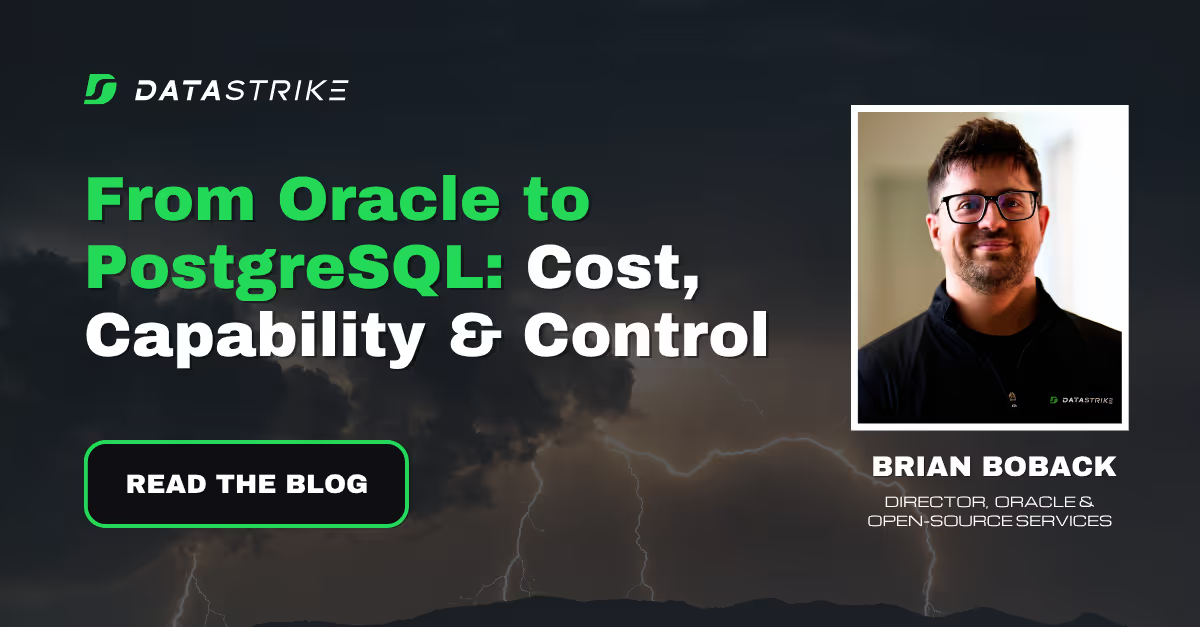
By Brian Boback, Director of Oracle and Open-Source Services at DataStrike
For decades, Oracle has been the backbone of mission-critical systems across large businesses and SMBs. Its performance, feature depth, and long-standing reliability have made it a gold standard, but recent demands have shifted the environment. Cloud-first strategies, agile development, and cost control are now front and center and organizations are feeling the tension. Oracle isn’t broken, the modern business model is just expanding. CIOs and other executives on the frontlines are asking: Does our current strategy align with where we're going or just where we've been?
PostgreSQL has entered the spotlight as a powerful open-source alternative that offers control, cost transparency, and cloud-native flexibility. But let’s be clear: the move from Oracle to PostgreSQL isn’t seamless. It’s not cheap in effort. And you will make compromises. The real question is, do the long-term benefits outweigh the short-term pain?
That’s where a Managed Service Provider (MSP) like DataStrike comes in. With experience supporting both Oracle and PostgreSQL environments, an MSP helps you assess trade-offs, mitigate risks, and migrate with precision. This isn’t about flipping a switch; it’s about navigating a complex transformation and doing it right.
Total Cost & Licensing
Oracle’s licensing structure is notoriously complex, built for an era of on-premises systems and predictable growth. Per-core pricing, virtualization restrictions, and support renewals make budgeting a challenge, especially in dynamic, cloud-based environments. PostgreSQL flips that model. As an open-source platform, there are no per-core fees or long-term licensing contracts. When deployed through cloud providers like AWS RDS or Azure Flexible Server, PostgreSQL offers transparent, usage-based pricing. Savings don’t appear magically, though.
SMBS & Enterprises often ask:
“Can you walk me through a three-year cost model (license, support, cloud) for Oracle vs PostgreSQL for our size and workload?”
An MSP helps build that model. They identify overprovisioning, right-size infrastructure, and avoid hidden costs in both scenarios. Whether you're comparing Oracle Autonomous Database with managed Postgres services, you need numbers rooted in context.
Functional Parity & Gaps
Oracle’s feature set is vast, and includes partitioning, compression, advanced security, and RAC. Many of these don’t have one-to-one equivalents in PostgreSQL.
PostgreSQL can match much of Oracle’s functionality with extensions like:
- pg_partman for partitioning
- pgcrypto for encryption
- Citus for distributed workloads
- TimescaleDB for time-series data
However, equivalency isn’t parity. As many teams have learned the hard way:
“Which Oracle features we rely on lack a true Postgres counterpart and what workarounds actually hold up in production?”
An MSP assesses your dependencies and maps each one carefully, offering realistic alternatives or hybrid models that bridge the gap. This isn’t a lift-and-shift. It’s a rebuild, with guardrails.
Performance & Scalability
Oracle excels with complex, procedural workloads, especially when PL/SQL logic is deeply embedded. PostgreSQL is just as capable, but performance optimization looks very different. It hinges on schema tuning, smart indexing, and resource-aware query planning.
Some teams have asked:
“For our workload heavy in joins and business logic, what real performance deltas have you seen between Oracle 23c and Postgres 16 or 17?”
Scaling also differs. While Oracle RAC and Data Guard are tightly integrated, PostgreSQL offers modular options like logical replication, read replicas, or sharding with Citus. But you likely need to rethink your architecture. That’s where MSPs benchmark current workloads, identify chokepoints, and implement tuning practices that play to PostgreSQL’s strengths, not try to mimic Oracle’s.
High Availability and Disaster Recovery
Availability is non-negotiable. Oracle’s RAC and Data Guard are mature, and battle tested. PostgreSQL offers flexibility, but achieving parity requires careful planning and tooling, think Patroni, pgBackRest, or cloud-native orchestration.
It’s why tech leads often ask:
“What RTO/RPO targets have you seen with native Postgres HA stacks, and how do they compare to Oracle's built-ins?”
MSPs define those targets, design geographically redundant systems, and validate failover mechanisms before they’re needed. This isn’t about building something “good enough”, it’s about building something bulletproof, even if it’s composed differently.
Migration Strategy & Risk
Migration is where the rubber meets the road, where the real transformation begins and the risk is highest. Oracle environments are often loaded with custom PL/SQL logic, complex triggers, object types, and OCI integrations. These don’t translate easily. You’re not just rewriting queries; you’re reconstructing logic.
“Based on our mix of PL/SQL, OCI calls, and Oracle-specific types, how long would a migration take? What tools (Ora2Pg, AWS DMS, EDB Migration) actually move the needle?”
An MSP brings structure to chaos. They build migration blueprints, convert code with automation (where possible), and maintain rollback plans. Just as critically, they prepare your team to operate the new system, closing knowledge gaps and providing support for the edge cases that inevitably pop up.
Ecosystem Maturity & Long-Term Flexibility
Oracle offers a tightly integrated, curated ecosystem with high standards for interoperability and governance. That makes for consistent operations, but also comes with less flexibility and more vendor lock-in. PostgreSQL, by contrast, evolves rapidly via a vibrant open-source community. The plugin ecosystem is deep and varied, offering both opportunity and risk, particularly if systems become over-customized or reliant on poorly maintained extensions.
Strategic teams ask:
“How quickly does the Postgres community deliver major features or patches, and what governance model prevents us from building a new monolith of plugins?”
To avoid sprawl, organizations need governance frameworks, observability standards, and extension policies, especially PostgreSQL environments scale.
Conclusion: Choosing the Right Tool for the Job
Migrating from Oracle to PostgreSQL isn’t about replacing something broken. It’s about choosing an architecture that supports the modern IT landscape, cloud-native, cost-efficient, and built for agility. Oracle continues to be a solid, enterprise-grade choice for many scenarios. PostgreSQL provides flexibility and freedom for organizations looking to modernize with open-source infrastructure.
Why DataStrike?
DataStrike is the largest onshore provider of managed data infrastructure services for small and mid-sized businesses (SMBs). We specialize in helping enterprises transition from legacy platforms to agile, modern architecture.
- Deep expertise in both Oracle and PostgreSQL environments
- Proven frameworks for low-risk, high-impact migrations
- 100% 24x7 onshore support, tailored to your internal team
- Ongoing optimization, governance, and performance tuning
- Strategic guidance to help you avoid recreating lock-in
Let’s take the next step together. Reach out to explore how we can modernize your infrastructure, reduce costs, and unlock control where it matters most. Contact us today to learn more.
More from DataStrike
.png)