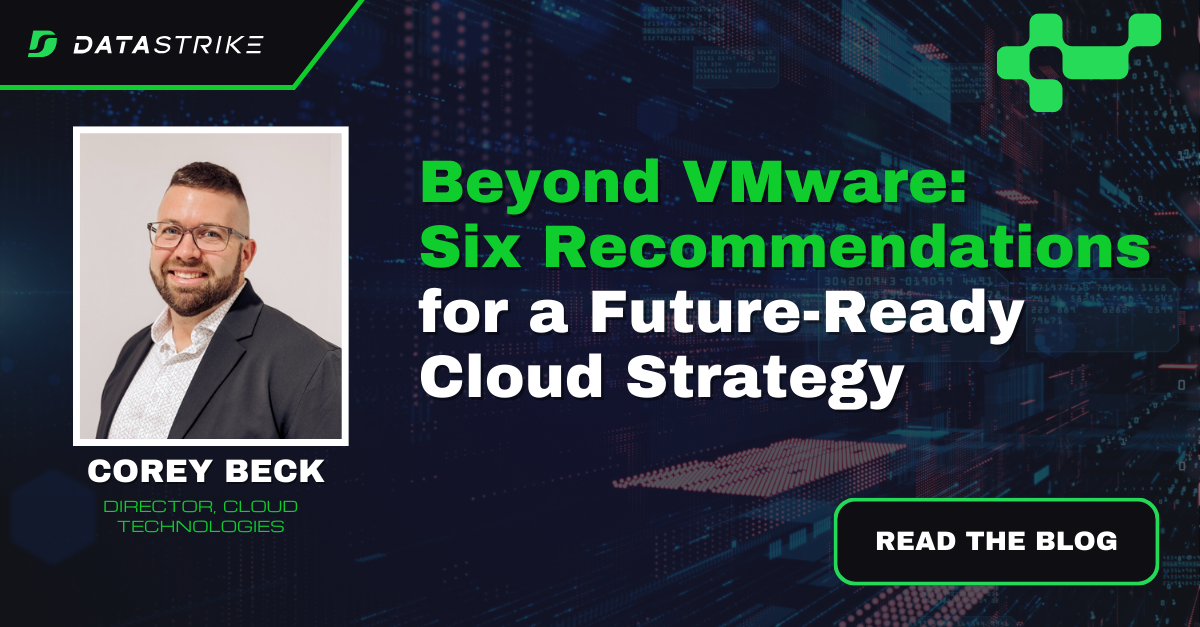
Beyond VMware: Six Recommendations for a Future-Ready Cloud Strategy
6 Ways to Build a More Flexible Cloud Strategy Beyond VMware
By Corey Beck, Vice President of Service Delivery at DataStrike
Introduction
For decades, VMware was the backbone of enterprise virtualization. Organizations built entire infrastructures on it, tying together automation, operations, and support under a single platform. VMware delivered stability at a time when businesses were just beginning to virtualize their workloads.
However, the landscape is changing. VMware’s renewal contracts are structured to lock customers into long-term agreements that are costly and inflexible. Licensing changes often introduce complexity without delivering new value, and the bundling of support services inflates costs even further. The result is a platform that feels less like a partner and more like a gatekeeper.
At the same time, cloud providers like AWS, Azure, and OCI have matured into platforms that meet or exceed enterprise requirements for security, performance, and compliance. These platforms offer scalability, automation, resilience, and transparent pricing models that VMware cannot match. They empower organizations to move faster, innovate more, and align IT with business strategy instead of vendor contracts.
At DataStrike, we see the same story repeating across industries: IT leaders want to innovate, but VMware’s licensing and renewal cycles hold them back. The time to rethink VMware is not six months before renewal but now, when you can still set the terms of your transformation.
1. Get Ahead of Renewal Pressure
VMware’s renewal structure is designed to put enterprises on the defensive. When your license is up for renewal, VMware holds all the leverage. You are forced to negotiate under time pressure, with limited options and significant disruption risk if you choose not to renew.
Organizations that get ahead of this cycle can flip the power dynamic. By migrating workloads to the cloud years before renewal, you steadily reduce VMware’s footprint in your environment. Each workload moved weakens their leverage and strengthens your ability to negotiate—or better yet, walk away from licensing you no longer need.
Take the example of a financial services firm facing renewal with more than 5,000 VMware-based workloads. If they had waited until renewal season, they would have been forced to sign a multi-year commitment worth millions. Instead, by working with a partner to move 20 percent of workloads to the cloud two years ahead of renewal, they entered negotiations with leverage. VMware’s terms were no longer the only option.
By 2027, more than 70 percent of enterprises will use industry cloud platforms to accelerate business initiatives, up from fewer than 15 percent in 2023. Enterprises that plan early will be positioned to take advantage of these platforms, while those that delay risk being locked into outdated models. At DataStrike, we help clients identify which workloads can and should move first. The goal is to create breathing room. You reduce VMware’s footprint well before renewal deadlines so that your organization negotiates from a position of strength.
2. Understand VMware’s Licensing
VMware’s licensing model has grown increasingly complex over the years. It is designed to maximize VMware’s revenue, not your operational efficiency. Bundled features, mandatory support, and limited scaling options create an environment where you pay more for less flexibility.
A typical VMware contract locks you in for three to five years. During that time, your business needs might change significantly. You may acquire another company, consolidate operations, or shift workloads to cloud-native platforms. Yet your VMware bill remains the same. It is essentially a tax on innovation.
The cloud takes the opposite approach. Providers like AWS and Azure operate on transparent, consumption-based pricing. You pay for what you use. If workloads increase, you scale up. If demand decreases, you scale down. That elasticity is critical in today’s business climate, where agility and cost optimization often mean the difference between leading and lagging competitors. According to Flexera’s 2024 State of the Cloud Report, 82 percent of enterprises cite cost savings and flexibility as their top reasons for cloud adoption. VMware’s rigid licensing model directly conflicts with these priorities.
DataStrike’s role is to help enterprises understand the hidden costs in VMware licensing. We build clear models comparing the long-term costs of staying with VMware versus migrating to the cloud. The results are almost always the same: cloud offers lower costs, greater flexibility, and more control over your IT future.
3. Migrate in Phases, Not All at Once
One of the biggest myths about cloud migration is that it has to be a “big bang” move. Enterprises look at their VMware environment (sometimes tens of thousands of virtual machines) and assume that the shift must happen all at once. That mindset is both unrealistic and risky.
The most successful migrations happen in phases. Organizations start with low-risk workloads such as dev/test environments, non-critical applications, or batch processing systems. These moves generate quick wins: cost reductions, faster deployment cycles, or improved scalability. Over time, confidence builds, and more complex workloads can be moved without disruption.
This phased approach also allows IT teams to modernize as they migrate. Instead of lifting and shifting everything exactly as it was in VMware, you can take advantage of cloud-native services. Databases can be migrated into managed services. Applications can be re-architected to use serverless platforms. Infrastructure can be codified using IaC for consistency and repeatability.
At DataStrike, we have guided clients through migrations involving thousands of workloads. The key is sequencing. Each phase should deliver measurable value while reducing risk. Over time, VMware becomes a smaller and smaller part of your IT portfolio until it is no longer the anchor holding back innovation.
4. Break Free From Bundled Support
VMware’s support model is one of the most expensive aspects of its ecosystem. Bundled packages often include features and services that organizations do not use but are required to pay for. Worse, VMware layers automation and management features into these bundles, making them nearly impossible to separate from the core platform.
Cloud providers approach support differently. Automation, monitoring, and security are built into the platform. Features like Infrastructure as Code, CI/CD pipelines, event-driven automation, and serverless computing are not add-ons. They are part of the ecosystem by default.
This is where enterprises see some of the most dramatic gains. By breaking free from VMware’s support bundles, you eliminate unnecessary costs and unlock new capabilities. With DataStrike, we help enterprises unlock these efficiencies. We replace expensive VMware support layers with automation strategies built directly into the cloud, enabling faster development cycles and lower operational costs.
5. Diversify to Reduce Risk
Vendor lock-in is one of the greatest risks in IT. Overreliance on VMware means your entire strategy is tied to one company’s licensing, pricing, and roadmap decisions. That is a dangerous place to be, especially when those decisions prioritize shareholder returns over customer outcomes.
Cloud diversification solves this problem. Workloads can be distributed across multiple providers such as AWS and Azure. Hybrid environments can balance on-premises stability with cloud scalability. This flexibility reduces the impact of outages, mitigates the risk of price increases, and ensures continuity even when one provider experiences issues.
DataStrike works with clients to design multi-cloud strategies that align with their specific needs. Some organizations need global reach, others need compliance with regional regulations, and still others simply want redundancy. Whatever the driver, diversification creates resilience that VMware alone cannot provide.
6. Align Spend With Cloud Strategy
The most important shift when moving away from VMware is aligning IT spend with business strategy. VMware licensing is fixed. You pay regardless of usage. That makes it nearly impossible to tie IT investments directly to business priorities.
Cloud spend is elastic and strategic. Every dollar spent directly supports workloads that generate value. If your business expands, cloud spend increases proportionally. If demand falls, cloud spend decreases. IT becomes an enabler of growth rather than a drain on resources.
DataStrike helps enterprises right-size their VMware environments to retain only what is truly necessary. Growth workloads and innovation projects are shifted to the cloud, where spend can flex with demand. This ensures that IT budgets align with long-term business goals rather than vendor contracts.
Why DataStrike?
Moving away from VMware is not just a technology decision. It is a strategic shift that impacts cost, operations, and culture. Organizations need a partner who can navigate the complexities of licensing, design phased migrations, and unlock the benefits of cloud-native automation.
DataStrike delivers this expertise. We have managed migrations across industries, from financial services to healthcare to manufacturing. Our phased approach ensures each step generates value while reducing risk. Our cost modeling makes the financial benefits clear to stakeholders. Our automation strategies empower teams to move faster with less overhead.
We do not believe in one-size-fits-all migrations. Some clients need a hybrid approach, others pursue full public cloud, and many fall somewhere in between. Our role is to guide you through the options, build a roadmap that fits your business, and execute with precision. With DataStrike, the move away from VMware is not just about cutting costs. It is about building an infrastructure strategy that is modern, resilient, and aligned with your future.
Conclusion
VMware was once the gold standard of enterprise virtualization. But today, its rigid contracts, expensive bundles, and outdated licensing models hold organizations back. The future belongs to the cloud, flexible, transparent, automation-rich, and resilient.
The time to act is not when your renewal is looming. By then, VMware already has the leverage. The time to act is now. Every workload you move ahead of renewal builds momentum. Every phase reduces cost and increases agility. Every step positions your business for what comes next.
DataStrike helps you make that transition with confidence. From phased migrations to cloud automation to multi-cloud diversification, we deliver the strategy and execution that put you back in control of your IT future. VMware may want to lock you into the past. With DataStrike as your partner, you can build for the future. Contact us today to learn more.
More from DataStrike

.png)