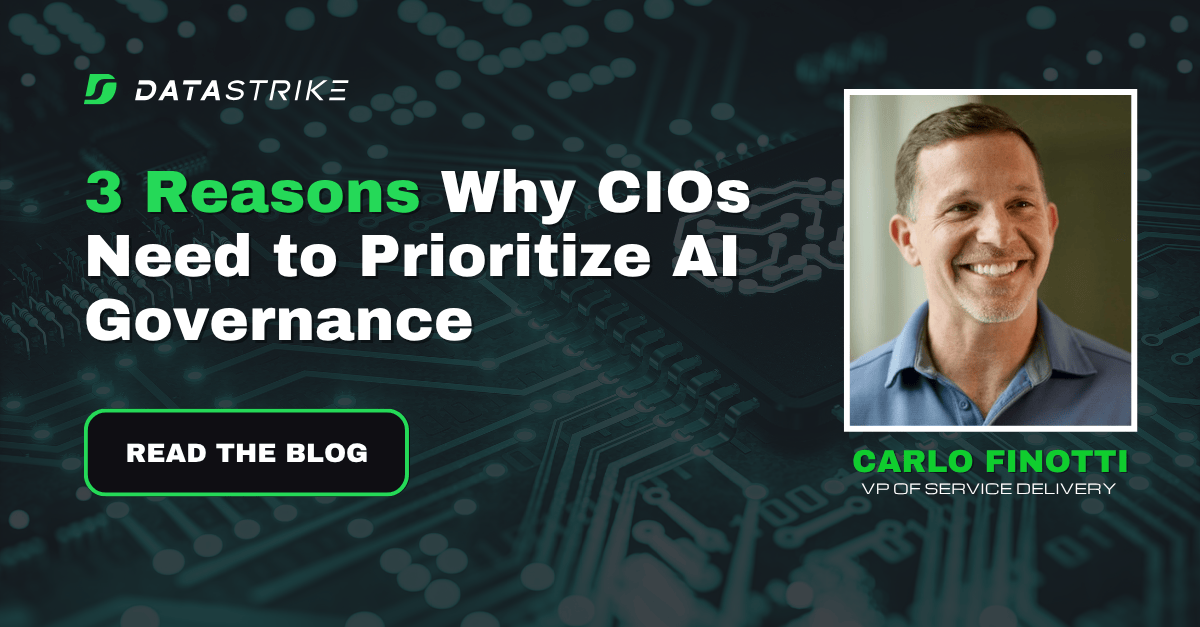
3 Reasons Why CIOs Need to Prioritize AI Governance
Why CIOs Can't Afford to Ignore AI Governance
The artificial intelligence revolution is no longer a distant future. It's happening right now in boardrooms, data centers, and daily operations across every industry. As Chief Information Officers (CIOs) navigate this transformative landscape, one critical question emerges: How do you harness AI's immense potential while safeguarding your organization from its inherent risks? The answer lies in establishing stringent AI governance frameworks that provide the strategic foundation for responsible AI deployment. For CIOs to prioritize AI governance isn't just a technical necessity. It's a business imperative that can determine the difference between AI success and catastrophic failure. Take it directly from me, I’ve been a CIO on the client-side before, and I can see the challenges and reasons behind AI Governance. This blog details the three reasons why AI governance should be at the top of every CIO's priority list.
1. Regulatory Compliance and Legal Risk Mitigation
The regulatory landscape surrounding artificial intelligence is evolving at breakneck speed, with new laws and compliance requirements emerging across multiple jurisdictions. The European Union's AI Act, which came into effect in 2024, represents the world's first comprehensive AI regulation, establishing strict requirements for high-risk AI systems and imposing significant penalties for non-compliance. Similarly, the United States has introduced executive orders and sectoral regulations addressing AI governance, while countries like China, Canada, and the UK are developing their own regulatory frameworks.
For CIOs, this regulatory complexity presents both immediate challenges and long-term strategic considerations. Organizations that fail to implement proper AI governance risk facing substantial financial penalties that can reach up to 6% of global annual revenue under the EU AI Act. Beyond monetary fines, companies may encounter legal liability for discriminatory outcomes or harmful AI decisions, regulatory investigations that can disrupt business operations, and market access restrictions in jurisdictions with strict AI compliance requirements.
The financial impact of regulatory non-compliance extends far beyond immediate penalties. Organizations may face class-action lawsuits, regulatory sanctions, and reputational damage that can affect customer trust, investor confidence, and competitive positioning. Recent cases have shown companies spending millions in legal fees and settlements after AI systems produced biased hiring decisions or discriminatory lending practices.
Proactive AI governance enables organizations to stay ahead of regulatory requirements by establishing compliance frameworks that can adapt to changing legal landscapes. This includes implementing documentation standards, audit trails, risk assessments, and accountability mechanisms that demonstrate responsible AI practices to regulators and stakeholders.
Key Compliance Elements:
- Comprehensive documentation of AI decision-making processes
- Regular audits and impact assessments for AI systems
- Clear data lineage and model explainability requirements
- Incident response procedures for compliance violations
- Staff training on regulatory requirements and ethical AI practices
Successful compliance strategies treat regulation not as a burden but as a competitive advantage. Companies with mature governance frameworks often find they can enter new markets more quickly, secure better partnerships, and build stronger customer relationships because of their demonstrated commitment to responsible AI practices.
2. Risk Management and Operational Resilience
Artificial intelligence systems introduce unique risks that traditional IT governance frameworks weren't designed to address. These AI-specific risks can manifest in unexpected ways, potentially causing operational disruptions, financial losses, and strategic setbacks that traditional risk management approaches may miss entirely.
Modern AI systems operate in complex, interconnected environments where small changes can have cascading effects across multiple business processes. Without proper governance, organizations face several critical risk categories that can severely impact business operations. Technical risks include model drift and performance degradation over time, data quality issues that compromise AI decision making, security vulnerabilities in AI algorithms and training data, and integration failures between AI systems and existing infrastructure.
Here’s a perfect example of how integral it is to shore up your systems: On August 1, 2012, Knight Capital Group experienced a software error in its trading algorithm that caused a flood of erroneous orders to hit the market, resulting in a loss of over $440 million in just 45 minutes. This incident, widely known as the Knight Capital trading error, demonstrated the critical need for rigorous testing, stringent risk management, and reliable monitoring in automated trading systems, as undetected flaws can lead to significant financial consequences and highlight the increasing complexities that AI will bring to such future systems.
Operational risks encompass overreliance on AI systems without adequate human oversight, lack of explainability in critical business decisions, inadequate testing and validation of AI models before deployment, and insufficient monitoring and alerting for AI system failures. These risks become particularly acute when AI systems are deployed in customer-facing applications or mission-critical business processes.
Effective Risk Management Strategies:
- Comprehensive risk assessment frameworks specific to AI systems
- Continuous monitoring and alerting for AI performance degradation
- Regular stress testing and scenario planning for AI failures
- Clear escalation procedures and human oversight mechanisms
- Vendor risk assessment and third-party AI evaluation processes
Organizations with mature AI governance capabilities report significantly lower rates of AI project failures and faster recovery times when issues do occur. Here at DataStrike, we have personally overseen companies with robust AI governance frameworks. On average, they experience 40% fewer AI related operational incidents and resolve issues 60% faster than organizations without formal governance structures.
The cost of AI system failures extends beyond immediate operational disruption. Companies may face customer defection, regulatory scrutiny, and competitive disadvantage that can persist long after technical issues are resolved. Effective risk management through AI governance transforms these potential liabilities into manageable business risks with clear mitigation strategies.
3. Competitive Advantage and Innovation Enablement
While AI governance is often viewed as a constraint on innovation, the reality is quite different. Well designed governance frameworks actually accelerate AI innovation by providing clear guidelines, reducing uncertainty, and creating structured approaches to experimentation and deployment. For forward-thinking CIOs, AI governance represents a strategic enabler that can differentiate their organizations in competitive markets.
Companies with mature AI governance capabilities consistently outperform their peers in several key areas. They achieve faster AI deployment through streamlined approval processes, standardized development and testing procedures, reusable governance templates and frameworks, and reduced time spent on compliance and risk assessment activities. This operational efficiency translates directly into competitive advantage as organizations can bring AI-powered products and services to market more quickly than competitors.
Higher success rates represent another significant advantage of strong AI governance. Organizations with established frameworks see better alignment between AI projects and business objectives, more effective resource allocation and project prioritization, improved stakeholder buy-in and organizational support, and enhanced ability to learn from failures and iterate quickly.
Sustainable innovation becomes possible when governance frameworks provide long-term strategic planning for AI capabilities and investments, balanced approaches to AI experimentation and risk management, strong partnerships with AI vendors, researchers, and industry experts, and continuous improvement processes that enhance governance effectiveness over time.
Innovation Acceleration Through Governance:
- Standardized AI development pipelines that reduce project timelines
- Clear decision-making frameworks that eliminate bureaucratic delays
- Risk-appropriate experimentation guidelines that encourage innovation
- Resource optimization through portfolio management approaches
- Knowledge sharing and best practice development across teams
These advantages become self-reinforcing as successful AI implementations generate additional resources and organizational support for future initiatives. Organizations also benefit from enhanced stakeholder confidence, including customers, investors, and regulators, who increasingly view AI governance as an indicator of organizational maturity and long-term sustainability. This confidence translates into tangible business benefits, including easier access to capital, stronger customer relationships, and reduced regulatory scrutiny.
Building Your AI Governance Framework
Establishing an effective AI governance framework requires a methodical, phased approach. It starts with executive sponsorship and works through cross-functional committees, policy creation, and system-level safeguards.
A strong foundation includes:
- Executive and board-level oversight
- AI governance committees with clear mandates
- Embedded reporting systems
- Integration with existing enterprise governance
An essential piece of this puzzle is aligning with international best practices. One such globally recognized reference is ISO/IEC 42001, the first AI Management System Standard developed by the International Organization for Standardization (ISO). You can view the official ISO framework here. ISO/IEC 42001 provides a structured methodology for implementing AI governance at scale; covering everything from transparency and accountability to data quality and ethical alignment. Forward-looking CIOs should look to these standards as a foundation for enterprise AI programs.
Critical Security and Data Protection Controls:
One of the most pressing concerns for organizations adopting AI is the protection of intellectual property (IP) and sensitive information such as personally identifiable information (PII). Companies want to adopt quickly but face significant privacy concerns about data loss or inadvertently training models with sensitive information that could be exposed or reconstructed later.
AI governance frameworks must incorporate robust security controls that address these specific risks. Data classification and handling procedures ensure that sensitive information is properly identified, labeled, and protected throughout the AI lifecycle. This includes implementing technical controls that prevent PII and proprietary data from being used in training datasets without proper anonymization or synthetic data generation.
Model security represents another critical area where IP protection is paramount. Organizations need controls that prevent model theft, reverse engineering, or unauthorized access to proprietary algorithms. This includes secure model storage, encrypted communications between AI systems, and access controls that limit who can view or modify trained models.
Essential Security Framework Elements:
- Data loss prevention (DLP) tools specifically configured for AI workflows
- Secure multi-party computation for collaborative AI without data sharing
- Differential privacy techniques to protect individual privacy in datasets
- Model watermarking and provenance tracking for IP protection
- Regular security audits and penetration testing of AI systems
- Secure development environments with air-gapped training capabilities
Implementation Best Practices:
- Start with pilot programs to demonstrate value and build confidence
- Focus on high-impact, low-risk AI applications in early phases
- Invest in training and change management to ensure adoption
- Establish clear metrics and reporting to track governance effectiveness
- Build flexibility into frameworks to accommodate rapid AI evolution
According to Gartner's AI ethics research, organizations with comprehensive AI governance frameworks achieve 25% better business outcomes from their AI investments compared to those with ad-hoc approaches.
The Strategic Imperative for AI Governance
The reasons for CIOs to prioritize AI governance have never been more compelling or urgent. As artificial intelligence becomes increasingly central to business operations and competitive strategy, the organizations that establish robust governance frameworks today will be the ones that thrive tomorrow.
About DataStrike
DataStrike is the industry leader in 100% onshore data infrastructure services and enables companies to harness AI and IT transformations as a catalyst for growth. With a network of highly specialized experts, strategic partnerships with the world's biggest technology providers, and a platform agnostic approach, DataStrike provides innovative AI governance solutions and practical guidance to accelerate digital transformation initiatives while ensuring responsible AI deployment for small-to mid-sized businesses. Contact DataStrike today to discover how we can help you build comprehensive AI governance frameworks that drive sustainable innovation while protecting your business from emerging risks.
About the Author
Carlo Finotti began his IT journey in 1998, progressing from Level 1 technical support to serving as Chief Information Officer. Over the past two decades, he has navigated the rise of the dot-com era and a wide range of economic and technological shifts. His career includes leadership roles at high-growth, private equity-backed companies such as rue21 and the North American Dental Group, as well as key contributions to private technical firms including XL.net and DataStrike.
Carlo’s unique perspective comes from his experience on both sides of the IT equation leading internal technology teams and collaborating closely with external service providers. Today, he serves as Senior Vice President of Service Delivery at DataStrike, where he applies this dual expertise to drive client outcomes and operational excellence.
More from DataStrike
.png)